1. I spent six weeks invigilating Eglantine by Margaret Salmon on the Isle of Skye, a feature film about a young girl exploring a Scottish forest and coastline alone. I was able to gain some insight on the ways that audience members interact with film installation. The film was being shown in a black box gallery within Dunvegan Castle which was set up as a casual screening room, with chairs arranged in the centre of the room and lots of space to stand around them or against the walls. Most of the audience were visitors to the castle who came upon the installation unexpectedly during their self-guided tour. Another video plays in a room on the same corridor in the castle with a similar layout of chairs and standing space. That video features a former Chief giving a history of the castle. A typical view of the installation was of an empty room with up to ten people crowded in the doorway and further outside the room, reluctant to walk into the space and apparently, to commit to viewing the work. After viewing for a few minutes, they were often eager to report on their experience and to compare it with an official reading of the work. In contrast, at the castle video, visitors were comfortable, always sitting, often chatting while the video played and accepted the content easily in the context of the castle. Of course, there are many reasons for these different attitudes to two videos with totally different content, but I think the context was significant. I believe that people recognised the visual culture setting of the film installation and that felt compelled to investigate the work for meaning.
2. Eglantine by Margaret Salmon expresses its environmentalist concerns in a celebration of nature in beautiful, lush film shots of wildlife and landscapes around rural Scotland. The film is a testimony to the value of nature. I was in its presence five times a day during the period that I was editing the third and fourth cuts of Kilcoole and the second cut of Coillte. Both of our works warn of the danger of neglecting the natural world but Salmon’s approach embraces the commercial appeal of natural beauty, making the audience want the same experience, whereas my videos were resisting and questioning that appeal completely. I was staying on the grounds of Dunvegan Castle and spending my free time walking round Dunvegan Loch, having more time in nature than I ever have before. My time spent with the installation made me more aware of what I was looking at, when my experience was lining up with Eglantine’s, and of the natural soundscapes around me. I found it very nourishing and affirming to be so engaged with the natural world during the editing process. I graded my establishing shots to look like the rich film shots of Eglantine.
3. Process: Testing
I discovered that testing was an efficient way for me to develop ideas I was turning over. At several points in the process, ideas, concepts and creative decisions that I had been labouring on for days or even weeks were instantly clarified by a practical test. There were also instances of testing in one area leading to new ideas in another.
Filming style was settled after testing different approaches. While editing some of those tests, I developed a soundtrack of natural field recordings of seagulls and dogs from the footage. I layered the audio so that these squawks and barks built to an unnatural warning crescendo. I was very interested in this distortion of natural sounds as an expression of the earthly trauma of plastic pollution. This became an important notion in the development of the sound sculpture.
After sketching out various video concepts from scraping flakes of plastic out of dissected food to humans coughing up lumps of plastic, I did some test videos from an overhead angle of a pair of disembodied hands examining vegetables that had developed plastic growths. Reviewing the footage, I liked that I had inadvertently imitated the ‘hands and pans’ style of food recipe video popular on social media as I felt this spoke to my concerns about consumer behaviour.
‘Hands and pans’ videos are very short and typically feature colourful props, extreme close ups of food and stop motion that skips through laborious tasks, dicing vegetables in one chop of the knife. They encourage a very passive viewing state and have a soporific effect, “that paradoxical sweet spot, where you are focused but completely passive”(Jones, 2018). The fetishisation of food in these videos, and the high production quality, with lustrous lighting and shots that foreground texture and sensation, echoed the concerns of my project with passive consumerism.
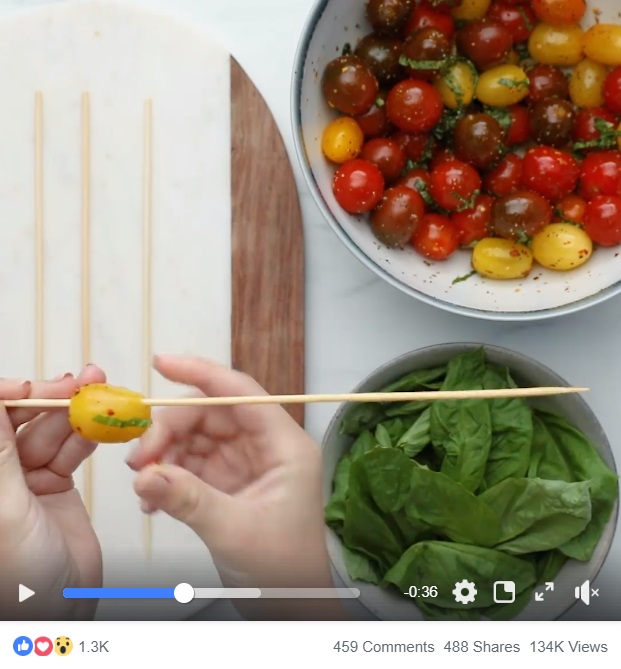
Although this video wound up being cut from the project due to a lack of cohesion with the other videos, I began to develop meditative beats in all of the videos to put viewers in this trance-like, receptive state as they observed the plastic threat which I hoped would allow them to absorb the images and atmosphere more easily.
 Aoife Carolan